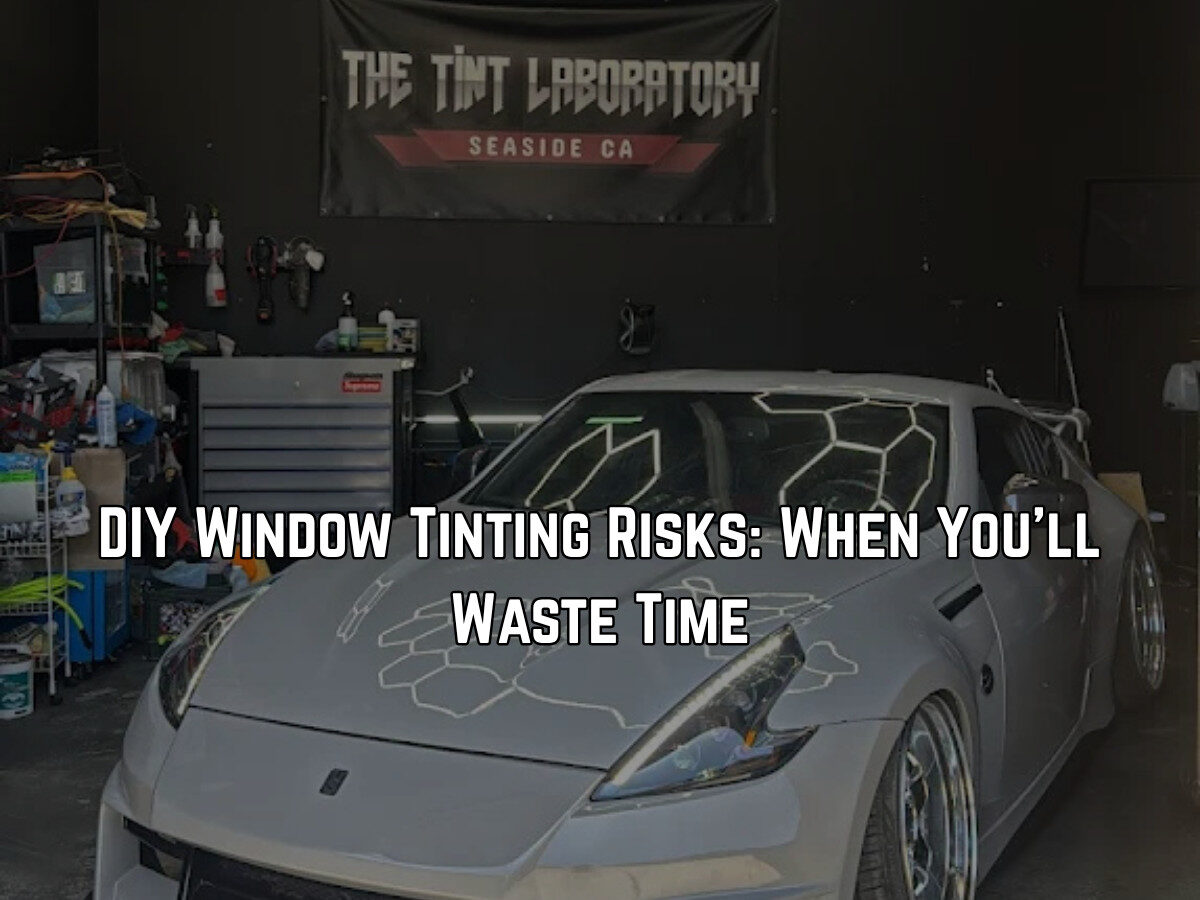
Quick Answer: DIY window tinting takes 8-10+ hours for a full car versus 2-4 hours professionally. Over 75% of DIY attempts fail due to improper preparation, resulting in bubbles, peeling, and uneven application. Most people spend more redoing failed DIY jobs than professional installation would have cost.
Key Takeaways:
- Professionals tint 2 windows in 90 minutes; DIYers need 4+ hours with frequent mistakes
- 75% of DIY tinting failures happen from insufficient surface preparation
- Failed DIY tint peels within days or weeks instead of lasting years
- You’ll need specialized tools, cleaners, and film that cost more than expected
- Legal compliance issues can result in tickets requiring complete removal
- Most DIY attempts require professional redo, doubling your total cost and time
You’re watching a YouTube video on window tinting. The host makes it look straightforward. Measure, cut, spray, apply, squeegee out bubbles. Twenty minutes later, they’re done.
So you buy a DIY kit. How hard could it be?
Turns out, pretty hard.
The Time Reality: What DIY Actually Takes
Let’s start with real numbers. A professional installer working on two windows finishes in about 90 minutes. That includes cleaning, measuring, cutting, applying, and finishing.
For someone doing it the first time? Plan on 4 hours minimum for those same two windows. And that’s if everything goes right.
A full car with four side windows and a rear window? Professionals need 2-4 hours total. DIY attempts routinely take 8-10 hours, spread across multiple days because you’ll need breaks from the frustration.
But here’s the catch: that’s just installation time. It doesn’t include the prep work nobody tells you about, the trips back to the store for supplies you forgot, or the time spent fixing mistakes.
The Hidden Prep Work That Eats Your Day
Before you touch the tint film, your windows need to be flawless. Not “looks clean to me” clean, surgically clean.
The Cleaning Phase: 2-3 Hours
You’ll spend 2-3 hours just on cleaning if you’re doing it right. This means:
- Removing all existing dirt, grime, and oils
- Scraping off old adhesive if removing previous tint
- Wiping down with distilled water (tap water leaves mineral deposits)
- Checking for dust particles under bright light
- Re-cleaning areas you thought were done
Research shows over 75% of DIY failures stem from insufficient preparation at this stage. One tiny piece of dust trapped under your film creates a bubble. One spot of oil prevents adhesion, causing peeling.
And here’s something nobody mentions: you need a clean, dust-free workspace. Your driveway won’t cut it. Wind carries particles. Your garage might work if you sweep thoroughly and let dust settle. Otherwise, you’re fighting a losing battle.
Measuring and Cutting: Where Most DIYers Fail
The film in those kits is expensive. You get one shot at cutting it correctly.
The Cutting Phase: 3-4 Hours
Professionals use computer-cut systems that produce perfect patterns in minutes. You’re working with a utility knife, trying to cut curves freehand while leaving enough overlap to work with.
Most DIY instructions say to cut the film with extra inches, then trim after application. Sounds reasonable until you realize:
- Cutting straight lines on sticky film is harder than it looks
- Curved windows require curved cuts that match exactly
- Every extra inch you leave is material you’ll struggle to trim later
- Trimming after application risks scratching your window or cutting too much
I’ve seen people spend 3 hours just cutting film for a sedan’s windows. And that’s before discovering their measurements were off.
Application: The Part Where It All Falls Apart
You’ve cleaned. You’ve cut. Now comes the moment of truth: actually putting the tint on the window.
The Application Phase: 3-4 Hours (If You’re Lucky)
This is where YouTube videos diverge sharply from reality. In videos, the installer sprays solution, smoothly applies the film, squeegees out water in a few passes, and moves on.
Your reality will likely include:
- The film sticking to itself instead of the window
- Air bubbles appearing faster than you can squeegee them out
- The film shifting and ending up crooked
- Dust particles landing on your wet film
- The squeegee creating streaks or scratches
- Edges that won’t stay down
- Corners that bunch up or fold over
One person reported spending 3 hours trying to eliminate air bubbles, only to give up and peel everything off.
And here’s a frustrating truth: if you mess up, you can’t just reposition the film. Once it’s stuck, peeling it off means starting over with new material. That $50 DIY kit? You’ll need to buy another one.
The Tools You Don’t Have
Professional installers use specialized equipment you probably don’t own:
- Heat guns to make film conform to curves
- Professional squeegees designed for tinting (not the ones at hardware stores)
- Precision cutting tools
- Tint-safe cleaning solutions
- Proper spray bottles
- Hard cards and soft cards for different squeegee jobs
- Sharp, dedicated blades
Buying all this adds another $50-100 to your “budget” DIY project. At this point, you’ve spent nearly what professional installation costs, except you’re doing all the work.
The Curing Problem Nobody Warns You About
Let’s say you somehow managed a decent installation. Congratulations, but you’re not done.
Window tint needs 3-7 days to cure. During this time, you cannot roll your windows down. At all. Not even a crack.
If you roll them down too early, the edges peel. The film shifts. Air gets underneath, creating bubbles. You’ve just ruined hours of work.
In Seaside’s moderate climate, you’re looking at about 3-5 days of curing. But if you did this in winter or during a foggy week, it might take 7-10 days. That’s over a week without using your windows.
Oh, and during curing, the tint will look hazy or blurry. This is normal, water is evaporating between the film and glass. But you can’t drive comfortably until it clears. Some people report blurriness lasting up to two weeks on DIY jobs because they trapped too much moisture during application.
Common DIY Failures: What Actually Happens
Let’s talk about what happens when DIY goes wrong, because it usually does.
Bubbles That Won’t Go Away
Air bubbles are the signature of amateur tinting. You’ll have them. The question is how many and how big.
Small bubbles might look like they’ll disappear as the tint cures. They won’t. They’ll grow. What starts as a pinpoint bubble becomes a quarter-sized bubble within days.
Large bubbles mean adhesive failure. You’re looking at complete removal and redo.
Peeling Within Days
Professional tint lasts 5-10 years before showing signs of age. DIY tint? It can start peeling within days or weeks.
Why? Because you didn’t clean thoroughly enough, didn’t prime the window correctly, or didn’t use proper techniques to ensure edge adhesion. Once peeling starts, it accelerates. You’ll watch it slowly work its way across your window.
Crooked and Uneven Edges
Getting tint to the exact edge of your window without gaps or overlap is nearly impossible without experience. You’ll likely end up with:
- Gaps at the top where you can see through
- Uneven lines along the edges
- Visible overlap where you tried to compensate
- Misaligned film that’s obviously crooked
This looks terrible. And once the film is stuck, you can’t fix it without removing everything and starting over.
Dust and Debris Trapped Underneath
Even in a clean environment, dust happens. That spec you didn’t notice during application? It’s now permanently trapped under your tint, creating a visible spot.
Multiple spots make your tint look dirty no matter how often you clean the outside.
Legal Compliance Issues
Here’s something many DIYers discover too late: tint darkness laws vary by state and are strictly enforced in California.
Your front side windows must allow 70% of light through. Most DIY kits come with 20% or 35% film. If you put that on your front windows, you’ve just made your car illegal to drive.
For window tinting in Seaside, knowing California’s laws before starting saves you from this expensive mistake.
When DIY Makes Sense (Spoiler: Rarely)
I’m not saying DIY window tinting is impossible. Some people pull it off. But the successful ones typically have:
- Previous experience with similar projects
- A professional-grade workspace
- All the right tools
- Patience to spend an entire weekend on one car
- Realistic expectations about results
- Backup plan for when it doesn’t work
If that’s not you, you’re gambling with your time and money.
The Real Cost Comparison
Let’s do the math on what DIY actually costs:
DIY Costs:
- Tint kit: $40-80
- Proper cleaning supplies: $20-30
- Additional tools you don’t have: $50-100
- Replacement film after first attempt fails: $40-80
- Your time: 10-15 hours at minimum wage = $150-225
- Potential ticket for illegal tint: $25-200
- Professional removal and redo after giving up: Full installation cost
Total DIY Cost: Easily $300-500 plus massive time investment, assuming you eventually get professional help.
Professional Installation: Quality professional installation covers everything-materials, labor, warranty, and guarantee of legal compliance.
The cost difference isn’t as large as you think. And the time difference is enormous.
What About “Saving Money”?
The main reason people try DIY is to save money. But here’s what happens in practice:
Most people who start with DIY end up paying for professional installation anyway, after wasting a weekend and $100-200 on supplies and ruined film.
They’ve now spent more than professional installation would have cost in the first place. Plus, they’ve lost a weekend they could have spent doing literally anything else.
Some try to stick it out with bad DIY tint. They live with the bubbles, the crooked edges, the peeling. They tell themselves it’s “not that bad” while secretly hating how their car looks.
The Professional Advantage: Why They’re Fast
Professionals make it look easy because they’ve done it thousands of times. They know:
- Exactly how much solution to spray
- The right squeegee pressure and angles
- How to work curves without creating bubbles
- Where films tend to fail and how to prevent it
- How to cut precisely for every vehicle model
- Which films work best for different windows
That 90-minute job isn’t just fast, it’s also higher quality than what you’ll achieve in 8 hours.
They also have proper facilities. Climate-controlled bays, professional lighting, and dust-free environments make a huge difference. Your garage or driveway can’t compete.
The Warranty Factor
Professional installation typically includes warranty coverage for:
- Bubbling
- Peeling
- Color fading
- Manufacturing defects
Your DIY job? No warranty. If something goes wrong, you start over on your own dime.
Good professional shops also guarantee their work. If there’s a problem, they fix it. With DIY, you’re on your own.
Alternative: Focus on What You’re Good At
Here’s a different perspective. Maybe you’re great at auto detailing or ceramic coating maintenance. Those are projects where DIY can make sense, regular cleaning and maintenance tasks that don’t require specialized installation skills.
Window tinting is different. It’s an installation job that requires specific expertise, tools, and conditions to do right. Even skilled DIYers often struggle with it.
Your time has value. Spending a weekend fighting with window film, only to end up with subpar results, isn’t saving money, it’s wasting it.
When You Absolutely Want to Try DIY Anyway
If you’re determined to attempt it despite everything I’ve said, here’s how to not make it worse:
Start Small: Practice on a small rear side window, not the most visible ones. You’ll learn without ruining your whole car.
Buy Quality Film: Cheap DIY kit film is inferior to professional-grade material. If you’re going to do this, at least use decent film.
Create the Right Environment: Work in a clean, enclosed space. Temperature matters, 60-80°F is ideal.
Watch Multiple Tutorials: Don’t rely on one video. Watch several from different sources to understand various techniques.
Have Realistic Expectations: Your first attempt won’t be perfect. Or good. It might not even be acceptable. That’s fine, you’re learning.
Budget for Redo: Assume you’ll need professional help eventually. Don’t put yourself in a financial spot where you can’t afford to fix failed DIY.
The Bottom Line
DIY window tinting sounds like a money-saving weekend project. In reality, it’s a time-consuming, frustration-filled endeavor that usually costs more than professional installation once you factor in wasted materials, your time, and the eventual professional redo.
The people who succeed at DIY tinting either have prior experience or are willing to accept mediocre results. Most people want their car to look good and perform well. For them, professional installation is the right choice.
Your time is valuable. Spending 10-15 hours over multiple days to get results that are worse than a professional would deliver in 3 hours doesn’t make financial sense, even if you “save” $100.
Consider this: would you rather spend a weekend frustrated with sticky film and stubborn bubbles, or drop your car off, go do something you enjoy, and pick it up a few hours later with perfect tint?
The answer usually becomes clear after the first failed attempt.
If you’re in the Seaside area and comparing your options, remember that professional installers also handle vinyl wraps and other customizatio